The Brinell Hardness Test
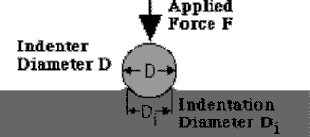
The Brinell hardness test method consists of indenting the test
material with a 10 mm diameter hardened steel or carbide ball subjected
to a load of 3000 kg. For softer materials the load can be reduced to
1500 kg or 500 kg to avoid excessive indentation. The full load is
normally applied for 10 to 15 seconds in the case of iron and steel and
for at least 30 seconds in the case of other metals. The diameter of
the indentation left in the test material is measured with a low
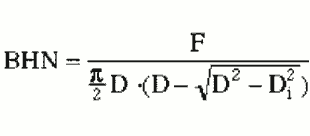
powered microscope. The Brinell harness number is calculated by
dividing the load applied by the surface area of the indentation.
 Larger View
The diameter of the impression is the average of two readings at right
angles and the use of a Brinell hardness number table can simplify the
determination of the Brinell hardness. A well structured Brinell
hardness number reveals the test conditions, and looks like this, "75
HB 10/500/30" which means that a Brinell Hardness of 75 was obtained
using a 10mm diameter hardened steel with a 500 kilogram load applied
for a period of 30 seconds. On tests of extremely hard metals a
tungsten carbide ball is substituted for the steel ball. Compared to
the other hardness test methods, the Brinell ball makes the deepest and
widest indentation, so the test averages the hardness over a wider
amount of material, which will more accurately account for multiple
grain structures and any irregularities in the uniformity of the
material. This method is the best for achieving the bulk or
macro-hardness of a material, particularly those materials with
heterogeneous structures.
Brinell Hardness Number Calculator
Links To:
Hardness Testing
Rockwell Hardness Test
Rockwell Superficial Hardness Test
Brinell Hardness Test
Vickers Hardness Test
Microhardness Test
Mohs Hardness Test
Scleroscope and other hardness testing methods
Hardness Conversion Tables and Charts:
Hardness Conversion Table(colour version - may take time to load)
Hardness Conversion Table(non-colour version)
Hardness Conversion Chart (1)
Hardness Conversion Chart (2)
Chart of Brinell, Vickers and Ultimate Tensile Strength Equivalents (1)
Chart of Brinell, Vickers andUltimate Tensile Strength Equivalents (2)
Hardness Conversion Table related to Rockwell C Hardness Scale (hard materials) (colour)
Hardness Conversion Table related to Rockwell C Hardness Scale (hard materials) (non-colour)
Hardness Conversion Chart related to Rockwell C Hardness Scales (hard materials)
Estimated Hardness Equivalent Chart related to Rockwell C and Vickers (hard materials)
Hardness Conversion Table related to Rockwell B Hardness Scale (soft metals) (colour)
Hardness Conversion Table related to Rockwell B Hardness Scale (soft metals) (non-colour)
Hardness Conversion Chart related to Rockwell B Hardness Scale (soft metals)
Table of Minimum Test Piece Thickness for Rockwell Hardness Testing using Ball Indenters
Table of Minimum Test Piece Thickness for Rockwell Hardness Testing using Diamond Indenters
HV, MPa and GPa Conversion Calculator

Telephone: +44 (0)1252 405186
Email: tsc@gordonengland.co.uk
Site Links
Introducing
Nature of Thermal Spray Coatings
Surface Engineering in a Nutshell
Surface Engineering Forum
Thermal Spray Gun Repair Service
Plasma Consumable Parts
Thermal Spray Powder Supplies
Applications:
Thermal Spray Coatings on Carbon and Glass Fibre Reinforced Polymers
HVOF Coating of Paper Making Roll
Abradable Coatings
Photomicrographs
Thermal Spray Processes:
Combustion Wire Thermal Spray Process
Combustion Powder Thermal Spray Process
Arc Wire Thermal Spray Process
Plasma Thermal Spray Process
HVOF Thermal Spray Process
HVAF Thermal Spray Process
Detonation Thermal Spray Process
Plasma Flame Theory
Cold Spray Coating Process
Wear and Use of Thermal Spray Coatings
Corrosion and Use of Thermal Spray Coatings
Glossary of Thermal Spray and Surface Engineering Terms
Image Directory for Thermal Spray Coatings
Plasma Gas Flow Information
Plasma Gas Flow Correction Calculator
Contact Form
Links to other interesting sites related to thermal spray and surface engineering
Reciprocal Links
Periodic Table of the Elements
SI Units
Calculators for Conversion between Units of Measurement
Hardness Testing
Surface Engineering Message Board Archive
Surface Engineering Message Board Archive Index
Photography Gallery
Photography Gallery3
© Copyright Gordon England