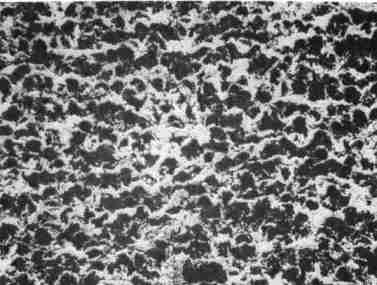
Plasma sprayed Aluminium Silicon Alloy / Polyester Abradable Coating
Abradable coatings are designed to preferentially abrade when contact is made with a mating part. Thermal spray abradable coatings have low structural integrity so they are readily abraded when they come into contact with a moving surface with higher structural integrity. The coatings are designed not to damage the mating surface.
There are a number of different abradable coating types, to cater for different operating temperatures, corrosive environments and mating materials. The coating structure can be either:
Plasma sprayed Aluminium Silicon Alloy / Polyester Abradable Coating
The main application of thermal spray abradable coatings is for gas path clearance control in gas turbine engines. In an ideal situation, gas turbine engines would be manufactured with minimal clearance in the gas seal locations, but in the real world these clearances are very much larger to permit operation without catastrophic interaction between rotor and the casing. The clearance at the gas seal locations has a significant effect on the gas turbine engine efficiency which directly translates to fuel consumption. Thermal spray abradable coatings successfully reduce these clearances to a minimum, without the risk of catastrophic failure.
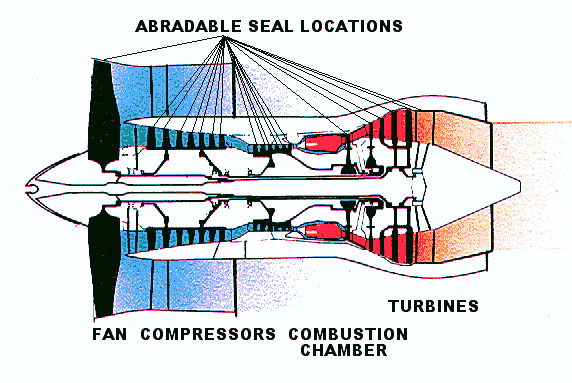
Schematic of a Typical Gas Turbine Engine
These coatings are used in the original manufacture to provide the best possible seals in the first instance. They are also used during overhaul to repair any excessive clearance produced during service. Substantial improvement in engine performance and efficiency can be realised by operating with clearances smaller than those achieved in the original manufacture where abradable coatings were not used.
This technology is now spreading to other applications, such as land based turbines and rotor seals in turbochargers for internal combustion engines.
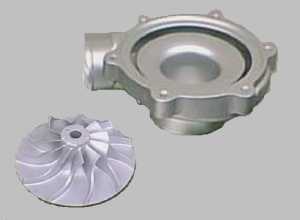
Thermal spray abradable coatings commonly used in order of increasing temperature capability:

Introducing
Nature of Thermal Spray Coatings
Surface Engineering in a Nutshell
Surface Engineering Forum
Thermal Spray Gun Repair Service
Plasma Consumable Parts
Thermal Spray Powder Supplies
Applications:
Thermal Spray Coatings on Carbon and Glass Fibre Reinforced Polymers
HVOF Coating of Paper Making Roll
Abradable Coatings
Thermal Spray Processes:
Combustion Wire Thermal Spray Process
Combustion Powder Thermal Spray Process
Arc Wire Thermal Spray Process
Plasma Thermal Spray Process
HVOF Thermal Spray Process
HVAF Thermal Spray Process
Detonation Thermal Spray Process
Plasma Flame Theory
Cold Spray Coating Process
Wear and Use of Thermal Spray Coatings
Corrosion and Use of Thermal Spray Coatings
Glossary of Thermal Spray and Surface Engineering Terms
Image Directory for Thermal Spray Coatings
Plasma Gas Flow Information
Plasma Gas Flow Correction Calculator
Contact Form
Links to other interesting sites related to thermal spray and surface engineering
Reciprocal Links
Periodic Table of the Elements
SI Units
Calculators for Conversion between Units of Measurement
Hardness Testing
Surface Engineering Message Board Archive
Surface Engineering Message Board Archive Index
Photography Gallery
Photography Gallery3
© Copyright Gordon England